

Breaking Into Tech Without a Degree: Proven Pathways
Breaking into tech without a degree is no longer a pipe dream—it’s a reality for thousands of professionals across the UK, US, and Europe. The tech industry has fundamentally shifted from credential-focused to skills-focused hiring, opening doors for talented individuals regardless of their educational background.
In fact, companies like Google, Apple, IBM, and Tesla have publicly removed degree requirements from many positions. This seismic change reflects a simple truth: what you can do matters more than where you studied.
If you’re considering a tech career without degree, this comprehensive guide reveals the exact pathways that are working for people just like you in 2025.
Master Upskilling for AI: Essential Tech Skills 2025
Why Tech Companies Are Dropping Degree Requirements
The traditional four-year computer science degree no longer holds monopoly status in tech hiring. Several forces have driven this transformation.
First, the pace of technological change has outstripped university curricula. By the time a degree program updates its coursework, the industry has moved on to new frameworks, languages, and methodologies.
Second, the skills gap crisis means companies desperately need talent. With over 150,000 unfilled tech positions across Europe alone, employers can’t afford to overlook qualified candidates based solely on credentials.
Third, successful self-taught programmer jobs have proven that motivation, practical skills, and problem-solving abilities often trump formal education. Companies now recognize that passionate learners who teach themselves can be exceptional employees.
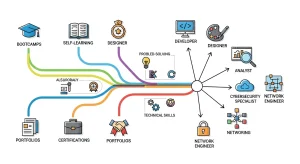
Pathway 1: Coding Bootcamps That Launch Careers
Tech bootcamp careers have exploded in popularity, and for good reason. These intensive, focused programs compress years of learning into 12-24 weeks of hands-on training.
Ace Your Virtual Interview 7 Powerful Remote Job Interview Tips
Top Bootcamp Options in 2025
General Assembly operates across London, Manchester, and major US cities, offering full-stack web development and data science programs with strong job placement support.
Le Wagon has expanded throughout Europe, providing excellent training in web development and data science with a 85% job placement rate within six months.
Flatiron School offers income share agreements, meaning you pay nothing upfront and only repay tuition after securing a job earning above a threshold salary.
Makers Academy in the UK focuses heavily on software craftsmanship and test-driven development, producing job-ready developers in 16 weeks.
What Makes Bootcamps Effective
Bootcamps succeed at breaking into tech without a degree because they:
- Focus exclusively on in-demand, practical skills
- Provide portfolio projects that demonstrate real capabilities
- Offer career coaching and employer connections
- Create accountability through cohort-based learning
- Teach current technologies that companies actually use
Graduates typically start at £25,000-£35,000 in the UK or $60,000-$80,000 in the US—solid entry points that grow rapidly with experience.
Green Investing ESG: Perfect Portfolio Strategy?
Pathway 2: Self-Taught Routes That Actually Work
The self-taught path offers maximum flexibility and minimum cost, though it requires exceptional discipline. Thousands have successfully pursued non-traditional tech careers through structured self-education.
Creating Your Self-Learning Curriculum
Phase 1: Foundation Building (3-4 months)
- Choose one programming language (Python or JavaScript recommended)
- Complete freeCodeCamp’s responsive web design certification
- Work through Harvard’s CS50 course on edX
- Build 3-5 simple projects to cement understanding
Phase 2: Specialization (4-6 months)
- Select a focus area: web development, data analysis, or mobile development
- Deep-dive into relevant frameworks (React, Django, Flutter)
- Contribute to open-source projects on GitHub
- Create portfolio pieces that solve real problems
Phase 3: Job Preparation (2-3 months)
- Practice technical interview questions on LeetCode
- Build a professional portfolio website
- Network in tech communities and attend meetups
- Apply strategically to junior positions
The total timeline runs 9-13 months of consistent effort. This tech career without degree pathway costs under £500 for premium courses and resources.
Budgeting for Inflation: Smart Finance Tips 2025
Pathway 3: Certifications That Employers Respect
While general certifications can’t replace skills, specific technical certifications carry significant weight for self-taught programmer jobs.
High-Value Certifications for Career Changers
Cloud Certifications:
- AWS Certified Solutions Architect
- Google Cloud Professional Cloud Architect
- Microsoft Azure Fundamentals
Development Certifications:
- Meta Front-End Developer Professional Certificate
- Google IT Support Professional Certificate
- Oracle Certified Professional Java Programmer
Data Certifications:
- Google Data Analytics Professional Certificate
- IBM Data Science Professional Certificate
- Tableau Desktop Specialist
These credentials demonstrate commitment and validate skills when you lack a formal degree. Many employers specifically filter for certified candidates, giving you visibility in applicant tracking systems.
DeFi Explained: The New Banking Disruptor
Pathway 4: Alternative Education Platforms
Beyond bootcamps and pure self-study, hybrid models have emerged that combine the best of both approaches for breaking into tech without a degree.
Udacity’s Nanodegree programs offer project-based learning with mentor support and career services. Their programs in data engineering, cloud computing, and full-stack development take 3-6 months and cost £300-£1,000.
Coursera’s Professional Certificates from Google, IBM, and Meta provide structured learning paths with career resources. Completion takes 3-6 months at £30-£50 monthly.
Pluralsight and LinkedIn Learning offer subscription-based access to thousands of courses, ideal for filling knowledge gaps while building broader skills.
BloomTech (formerly Lambda School) provides full computer science education with income share agreements, eliminating upfront costs.
Tiny House Living: Maximize Space & Minimize Costs
Building a Portfolio That Gets You Hired
Regardless of which pathway you choose for your tech career without degree, your portfolio determines hiring success.
Portfolio Projects That Impress
For Web Developers:
- A full-stack application with user authentication
- A responsive website for a real client or nonprofit
- An API that solves a specific problem
- Contributions to established open-source projects
For Data Analysts:
- Analysis of publicly available datasets with clear insights
- Interactive dashboards using Tableau or Power BI
- Predictive models with documented methodology
- Data cleaning and visualization case studies
For UX/UI Designers:
- Complete redesign of an existing application
- User research and wireframing documentation
- High-fidelity prototypes in Figma
- Before-and-after case studies
Host everything on GitHub with comprehensive README files explaining your process, challenges overcome, and technologies used.
Networking Your Way Into Tech
Non-traditional tech careers often begin through connections rather than applications. Strategic networking accelerates your journey.
Attend tech meetups in your city through Meetup.com. Join online communities like Dev.to, Hashnode, and relevant Discord servers. Participate in Twitter conversations using hashtags like #100DaysOfCode.
Consider these networking strategies:
- Cold outreach to developers whose careers you admire
- Content creation through blogging or YouTube to demonstrate knowledge
- Hackathons to meet potential employers and collaborators
- Open-source contributions that get you noticed by project maintainers
- LinkedIn activity sharing your learning journey and engaging with tech content
Many self-taught programmer jobs come from referrals. Build genuine relationships before asking for opportunities.
Entry-Level Roles Perfect for Career Changers
Certain positions welcome candidates pursuing breaking into tech without a degree more readily than others.
Junior Front-End Developer roles focus on HTML, CSS, and JavaScript—skills you can demonstrate through visual projects that non-technical hiring managers appreciate.
QA Tester/Engineer positions require less coding initially but provide entry into development teams where you can learn continuously.
Technical Support Specialist roles leverage your customer service skills while exposing you to technical systems and potential internal mobility.
Data Analyst positions value problem-solving and communication as much as technical skills, making them accessible transition roles.
Junior DevOps Engineer jobs are increasingly open to bootcamp graduates who understand CI/CD pipelines and cloud platforms.
Target companies with “skills-first” hiring policies and growing engineering teams that need multiple experience levels.
Realistic Timeline and Expectations
Tech bootcamp careers typically launch within 6-12 months from starting education to landing the first job. Self-taught routes average 12-18 months depending on your available study time.
First salaries for tech career without degree professionals range from £22,000-£40,000 in the UK and $50,000-$80,000 in the US. Within 2-3 years, salaries typically reach £40,000-£60,000 or $80,000-$120,000 respectively.
Remote opportunities have exploded, with over 60% of tech jobs now offering partial or full remote work. This geographic flexibility particularly benefits those breaking into tech without a degree by expanding your job market dramatically.
Your Tech Career Starts Now
The barrier to non-traditional tech careers has never been lower. Companies need your skills, pathways exist to develop those skills affordably, and the potential for rewarding work and strong compensation awaits.
Choose your pathway based on your learning style, financial situation, and timeline. Commit to consistent progress rather than perfection. Build projects that showcase your abilities. Connect with the community.
Your tech career doesn’t require a degree. It requires determination, strategic learning, and persistent effort. Thousands before you have made this transition successfully. You can too.
The only question is: when will you start?