
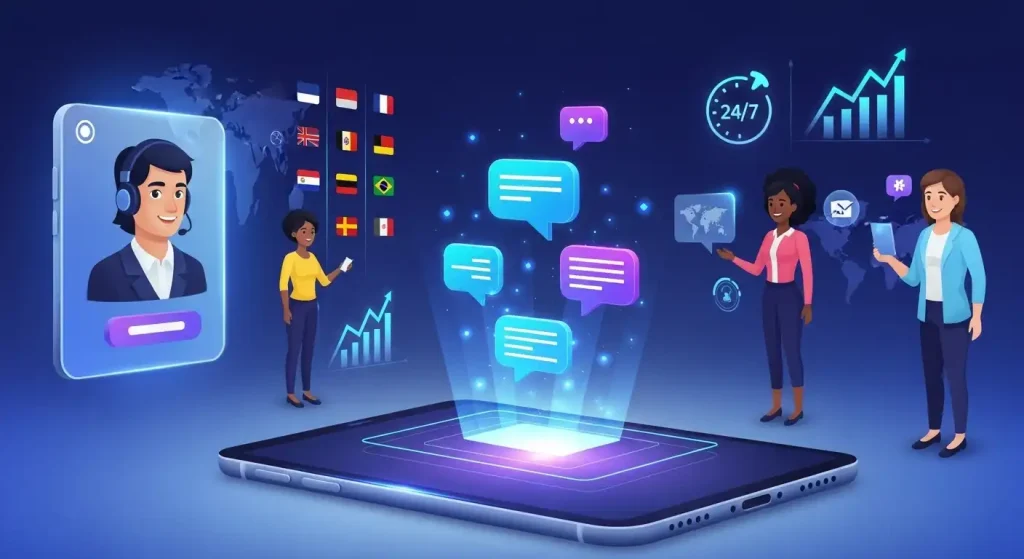
The customer service landscape is undergoing a seismic shift, and AI chatbots are at the center of this transformation. By 2025, 95% of customer interactions are expected to be AI-powered U.S. News & World Report, fundamentally changing how businesses engage with their customers. This isn’t just another technological trend—it’s a revolution that’s redefining what exceptional customer service looks like.
Whether you’re a small business owner looking to scale support operations or an enterprise seeking to enhance customer satisfaction while reducing costs, understanding how AI chatbots are transforming customer service is no longer optional. These intelligent virtual assistants are handling everything from simple FAQs to complex problem-solving, operating around the clock, and delivering experiences that customers increasingly prefer.
In this comprehensive guide, we’ll explore how AI chatbots are reshaping customer service, the tangible benefits they provide, and why businesses that fail to adopt this technology risk falling dangerously behind their competitors.
Tax Deductions for Freelancers and Small Businesses: Maximize Your Tax Savings
What Are AI Chatbots for Customer Service?
AI chatbots for customer service are sophisticated software programs that use artificial intelligence, natural language processing, and machine learning to simulate human-like conversations with customers. Unlike their primitive predecessors that relied on rigid decision trees, modern AI-powered chatbots can understand context, detect emotions, and provide personalized responses that feel genuinely human.
AI chatbots use natural language processing or machine learning to understand customer requests and improve with each interaction Sure Oak. They learn from every conversation, continuously refining their ability to provide accurate, helpful responses that resolve customer issues efficiently.
Think of AI customer service chatbots as tireless team members who never need breaks, never have bad days, and can handle thousands of conversations simultaneously. They’re available when your customers need them most—whether that’s at two in the morning or during the busiest shopping season of the year.
Advanced natural language understanding revolutionizes customer service chatbots, allowing them to understand and process customer interactions, detecting intent and meanings no matter the phrasing and grammar Granwehr. This capability transforms chatbot technology from frustrating automated systems into genuinely helpful assistants that enhance the customer experience.
The Rise of AI Chatbots in Customer Service
The adoption of AI chatbots in customer service isn’t just growing—it’s exploding. The numbers tell a compelling story of transformation:
The AI chatbot market was valued at seven point seven six billion dollars in 2024 and is projected to reach twenty-seven point two nine billion dollars by 2030, representing a compound annual growth rate of twenty-three point three percent Money. This explosive growth reflects businesses’ recognition that AI chatbots deliver measurable results in customer satisfaction, operational efficiency, and bottom-line performance.
Eighty percent of companies are either using or planning to adopt AI-powered chatbots for customer service by 2025 Ucu, signaling that chatbot adoption has moved from experimental to essential. Companies that delay implementation aren’t just missing opportunities—they’re allowing competitors to establish superior customer service experiences that will be difficult to match.
Twenty-seven percent of shoppers interact with chatbots daily U.S. News & World Report, demonstrating that consumers have embraced this technology as a preferred method for getting quick answers and resolving issues. The stigma that once surrounded automated customer service is rapidly disappearing as AI chatbots become more sophisticated and helpful.
Beginner’s Guide to Student Loan Refinance: Lower Rates & Save Money
Key Benefits of AI Chatbots for Customer Service
The transformation AI chatbots are bringing to customer service manifests in multiple powerful benefits that impact both businesses and customers.
24/7 Availability and Instant Responses
Customer problems don’t respect business hours, and neither should your support system. Because chatbots never sleep, they can provide global, twenty-four seven support at the most convenient time for the customer, even when agents are offline Sure Oak.
No matter what time of day or night a customer reaches out, they can receive instant assistance from an AI chatbot NerdWallet. This constant availability meets modern customer expectations for immediate service and dramatically improves the overall customer experience. When customers encounter issues at midnight or during holidays, AI-powered chatbots provide reliable assistance without requiring businesses to maintain expensive around-the-clock staffing.
The impact on customer satisfaction is substantial. Rather than waiting hours or days for email responses or enduring lengthy phone queues, customers receive immediate acknowledgment and often complete resolution of their issues within seconds.
Dramatic Cost Reduction
While improving service quality, AI chatbots simultaneously slash operational costs. Conversational AI will reduce contact center agent labor costs by a staggering eighty billion dollars by 2026, with ten percent of agent interactions expected to be automated Research.com.
The financial benefits extend beyond labor savings. Support teams can handle greater interaction volumes while lowering costs by letting chatbots answer frequent questions, act as extra support representatives, and triage support requests Granwehr. Businesses no longer need to scale their support teams linearly with growth—AI chatbots provide the scalability necessary to handle increasing customer volumes without proportional cost increases.
Chatbots present the option to reduce twenty-four by seven staffing expenses or even eliminate after-hours staffing costs, provided chatbots can effectively handle most questions Ranktracker. For small businesses and startups with limited resources, this cost efficiency makes enterprise-level customer service accessible and affordable.
Investing Basics: Index Funds for Long-Term Growth
Enhanced Response Speed and Efficiency
Speed matters in customer service, and AI chatbots excel at delivering rapid responses. AI helped human agents respond to chats some twenty percent faster, improving performance even more for less experienced agents SoFi.
This speed improvement isn’t just about quick acknowledgment—it’s about complete resolution. AI customer service chatbots can instantly access knowledge bases, customer histories, and product databases to provide comprehensive answers without the delays inherent in human agents searching through systems or consulting colleagues.
By automating routine queries, chatbots allow human agents to focus on complex issues, improving productivity by seventy percent CNBC. This hybrid approach optimizes both speed and quality, ensuring simple questions get instant automated responses while complex issues receive the thoughtful human attention they require.
Improved Customer Satisfaction
Perhaps surprisingly to skeptics, AI chatbots are actually improving customer satisfaction scores. Fifty-one percent of consumers say they prefer interacting with bots over humans when they want immediate service Data Insights Market, reflecting a fundamental shift in customer preferences.
AI-powered chatbots leverage natural language processing to engage users in contextually relevant conversations, mirroring human interactions LendEDU. When implemented properly, these intelligent systems provide consistent, accurate, and helpful responses that meet or exceed customer expectations.
The emotional element matters too. The technology helped humans reply with more empathy and thoroughness, uniquely human service strengths with the potential to positively impact revenue and profitability by making for happier customers SoFi. AI chatbots don’t replace the human touch—they enhance it by handling routine matters efficiently, freeing human agents to focus on situations requiring genuine empathy and nuanced judgment.
Scalability During Peak Periods
Every business experiences demand fluctuations—seasonal spikes, product launches, or unexpected issues that trigger support request surges. Customer service chatbots can protect support teams from spikes in inbound support tickets, freeing agents to work on high-value tasks Granwehr.
Traditional customer service models require maintaining excess capacity or accepting degraded service during peak periods. AI-powered chatbots eliminate this dilemma by handling unlimited simultaneous conversations without performance degradation. Whether you’re serving ten customers or ten thousand, chatbot technology delivers consistent response quality and speed.
How to Pay Off Credit Card Debt Fast: Proven Strategies That Work
Multilingual Support
Global businesses face the challenge of serving customers who speak different languages. AI-powered chatbots can be programmed to understand and communicate in multiple languages, ensuring that customers worldwide receive support in their preferred language NerdWallet.
This multilingual capability isn’t just translation—AI chatbots understand cultural nuances and idiomatic expressions across languages, providing natural conversations that feel authentic to native speakers. For businesses expanding internationally, conversational AI eliminates language barriers without requiring multilingual support teams in every time zone.
Data Collection and Insights
Beyond resolving individual customer issues, AI chatbots generate valuable business intelligence. With the use of customer data provided by chatbots, businesses can expand their knowledge base on issues that plague customers during their service experience Laurel Road.
Every chatbot conversation provides insights into customer pain points, product confusion, feature requests, and service gaps. This continuous feedback loop enables businesses to proactively improve products, refine documentation, and optimize customer experiences based on real interaction data rather than assumptions.
How AI Chatbots Transform Different Aspects of Customer Service
The impact of AI chatbots extends across every dimension of customer service operations, fundamentally changing how businesses deliver support.
First-Line Support and Triage
AI customer service chatbots excel at serving as the first point of contact, instantly categorizing and either resolving or routing customer inquiries. Chatbots can serve as the initial support line, assist your support team during peak periods, or alleviate the burden of monotonous and repetitive questions, enabling human agents to focus on more complex issues Ranktracker.
This triage function ensures that simple questions get immediate automated resolution while complex issues reach qualified human agents quickly, complete with context and customer history. The result is faster overall resolution times and more efficient use of human expertise.
Planning for Retirement: Tips for Millennials
Self-Service Empowerment
Modern customers increasingly prefer finding answers themselves rather than contacting support. Chatbots that share knowledge from FAQ pages serve as an automated knowledge base, providing instant answers to common customer queries NerdWallet.
AI-powered chatbots make self-service genuinely effective by understanding natural language questions and surfacing relevant knowledge base articles, video tutorials, or documentation. Customers can describe problems in their own words rather than searching through structured menus or guessing correct search terms.
Proactive Customer Engagement
Advanced AI chatbots don’t just wait for customers to ask questions—they proactively reach out with relevant information. The chatbot uses real-time intent analysis to anticipate customer needs, offering tailored recommendations and reminders, such as notifying customers about abandoned carts or upcoming appointments CNBC.
This proactive approach transforms customer service from reactive problem-solving into preventative relationship management. By anticipating needs and addressing potential issues before they become problems, AI chatbots enhance customer satisfaction and loyalty.
Agent Augmentation and Training
One of the most powerful aspects of AI chatbots is how they enhance human agent performance. Researchers estimate that agents would need almost a year and a half of work experience to produce those improvements on their own. Now AI can help boost newer agents along the learning curve SoFi.
Gen AI innovations are already helping boost agent efficiency with case summaries or email text generation, reporting eighty percent savings of the time it takes to create a case summary, and agents spending eighty percent less time typing when resolving a support request Bankrate. This augmentation allows newer agents to perform at senior levels quickly while enabling experienced agents to handle more complex situations efficiently.
How to Save Money on Groceries Each Month
Real-World Applications of AI Chatbots in Customer Service
Understanding how businesses across industries are leveraging AI chatbots illustrates the practical value of this technology.
E-commerce and Retail
Online retailers use AI customer service chatbots to handle product questions, track shipments, process returns, and provide personalized shopping recommendations. The instant availability and product knowledge chatbots offer significantly reduce cart abandonment and increase conversion rates.
Banking and Financial Services
Approximately forty-six percent of financial institutions employing AI have reported improvements in customer experience, with seventy-nine point five percent planning to increase investments Ucu. Financial institutions use chatbot technology for account inquiries, transaction disputes, fraud alerts, and basic financial guidance, providing secure, immediate assistance while protecting sensitive information.
Healthcare
NIB Health Insurance saved twenty-two million dollars through AI-driven digital assistants, reducing customer service costs by sixty percent Ucu. Healthcare organizations deploy AI-powered chatbots for appointment scheduling, symptom assessment, prescription refills, and insurance inquiries, improving access to care while reducing administrative burden.
Telecommunications
Telecommunications companies leverage conversational AI to troubleshoot technical issues, explain billing, manage account changes, and provide service coverage information. The technical complexity and high call volumes in this industry make AI chatbots particularly valuable.
Budgeting Tips for Young Adults: Achieve Your First Savings Goal
Challenges and Limitations of AI Chatbots
While AI chatbots offer tremendous benefits, understanding their limitations ensures realistic implementation and optimal results.
The Trust and Emotional Connection Gap
The biggest roadblock to AI chatbot adoption is emotional connection. Customers often feel that chatbots lack the nuance, empathy, and understanding that human agents provide Marketkeep. While technology continues improving, certain situations inherently require human judgment, empathy, and creativity that AI cannot yet replicate.
Almost one-half of customers think AI agents can be empathetic when addressing concerns, and sixty-nine percent of organizations believe generative AI can help humanize digital interactions Data Insights Market. However, businesses must carefully balance automation with human availability, ensuring customers can easily escalate to human agents when needed.
Implementation and Integration Challenges
The most common mistake is releasing chatbots into an organization’s ecosystem without implementing the proper processes and human support needed to make them a success Marketkeep. Successful AI chatbot deployment requires thoughtful integration with existing systems, comprehensive training on company knowledge, and ongoing maintenance to ensure accuracy.
Knowledge Base Maintenance
Chatbots that rely on outdated knowledge bases or fail to learn from previous interactions risk delivering irrelevant responses, frustrating customers, and damaging brand reputation Marketkeep. Businesses must establish feedback-driven improvement processes where user interactions and performance metrics guide regular updates and retraining.
Boundary Recognition
AI customer service chatbots must recognize when they’ve reached the limits of their capabilities. When customers were transferred to human agents after their initial engagement with AI chatbots, the technology responded so fast that some customers felt they were still communicating with a chatbot, leading to less improvement in customer sentiment scores SoFi.
Successful implementations ensure seamless handoffs to human agents, clearly communicate when customers are interacting with AI versus humans, and provide easy escalation paths for complex situations.
Ultimate City Travel Guide 2025: Best European & US Destinations
Best Practices for Implementing AI Chatbots
Maximizing the benefits of AI chatbots requires strategic implementation aligned with business goals and customer needs.
Start with Clear Objectives
Before deploying chatbot technology, define specific goals. Are you aiming to reduce response times, lower costs, improve satisfaction scores, or handle volume spikes? Clear objectives guide implementation decisions and provide metrics for measuring success.
Focus on High-Volume, Repetitive Queries First
Forty-three percent of companies are investing in AI, chatbots, and automation to improve speed and scalability in support Research.com. Begin by automating the most common, straightforward customer inquiries—password resets, order tracking, basic account information, and frequently asked questions.
This approach delivers quick wins, builds organizational confidence in AI chatbots, and allows you to refine the technology before tackling more complex scenarios.
Maintain the Human Touch
AI bots won’t replace customer service agents—they are a tool that enhances the experiences of both businesses and consumers. Customers will always want to know they can talk to another human, especially regarding issues that benefit from a personal touch Sure Oak.
Design your customer service chatbot system with easy escalation to human agents. Display clear options for speaking with people, and ensure chatbots recognize when situations exceed their capabilities.
Train Continuously and Update Regularly
AI customer service bots track how people respond to every answer they provide, collect data, and gain knowledge to determine which response is best in each type of situation Sure Oak. Establish processes for reviewing chatbot performance, identifying gaps in knowledge, and incorporating learnings into ongoing training.
Regular updates ensure your AI-powered chatbots remain current with product changes, policy updates, and evolving customer needs.
Monitor Performance and Iterate
It’s essential to choose a bot solution that tracks its impact on your overall service performance, monitoring key metrics such as resolution rates, customer satisfaction, and efficiency gains Granwehr.
Track metrics like resolution rate, escalation rate, customer satisfaction scores, average handling time, and deflection rates. Use this data to continuously refine and improve your chatbot’s performance.
Ensure Proper Training for Human Agents
Seventy-two percent of CX leaders say they’ve provided adequate training for generative AI tools, but fifty-five percent of agents say they haven’t received any training Data Insights Market. Bridge this gap by providing comprehensive training on how AI chatbots work, when they should be used, and how to effectively collaborate with automated systems.
Indoor Gardening & Houseplants: Your Complete Guide to Growing a Thriving Indoor Garden in 2025
The Future of AI Chatbots in Customer Service
The trajectory of AI chatbots points toward even more sophisticated capabilities and deeper integration into customer service operations.
Enhanced Emotional Intelligence
By 2025, breakthroughs in conversational AI and large language models will make chatbot interactions more intuitive and human-like, allowing chatbots to understand context, emotions, and even complex queries CNBC. Real-time sentiment analysis will enable chatbots to gauge customer emotions during interactions and adjust responses accordingly.
Voice-Enabled Chatbots
Voice-enabled chatbots represent a significant growth area, as businesses recognize the natural appeal of conversational interfaces moving beyond simple command recognition to support nuanced, context-aware dialogue Studentloansherpa. The integration of advanced speech processing allows customers to engage more intuitively, particularly in mobile and hands-free environments.
Integration with Advanced AI Models
The integration with powerful generative AI models like GPT-4 and Claude is revolutionizing chatbot capabilities. These advanced systems can understand complex queries, provide detailed explanations, and maintain coherent conversations across multiple topics Studentloansherpa.
This technological leap enables AI customer service chatbots to handle sophisticated scenarios that previously required human intervention, further expanding the boundaries of what automated service can accomplish.
Predictive and Proactive Service
Future AI-powered chatbots will move beyond reactive problem-solving to predictive service that anticipates issues before customers experience them. By analyzing patterns in customer behavior, product usage, and historical data, chatbots will proactively reach out with solutions, maintenance reminders, and personalized recommendations.
Seamless Omnichannel Experiences
Leveraging voicebots and chatbots, conversational AI can automate entire customer interactions or assist in part, across both voice and digital channels Research.com. Future implementations will provide consistent, context-aware experiences whether customers engage through websites, mobile apps, messaging platforms, voice assistants, or phone calls.
Making the Decision: Is AI Chatbot Technology Right for Your Business?
While the benefits of AI chatbots are compelling, the decision to implement them should be strategic and informed.
All businesses, regardless of industry or size, can greatly benefit from chatbots to offer twenty-four seven live agent support and reduce customer support costs NerdWallet. However, successful implementation depends on several factors:
You Should Consider AI Chatbots If:
- You receive high volumes of repetitive customer inquiries
- Your customers need support outside traditional business hours
- You’re experiencing rapid growth that strains support resources
- Customer wait times are negatively impacting satisfaction
- You want to reduce operational costs without sacrificing service quality
- You’re expanding into international markets requiring multilingual support
Implementation May Need More Planning If:
- Your customer inquiries are highly complex and variable
- Personal relationships are central to your service model
- You lack the technical resources for proper integration
- Your knowledge base is poorly organized or outdated
- Your team isn’t prepared to collaborate with AI systems
The key is viewing AI customer service chatbots as tools that augment rather than replace human capabilities. Businesses that successfully blend automated efficiency with human empathy create customer experiences that outperform purely human or purely automated approaches.
Frequently Asked Questions About AI Chatbots for Customer Service
How do AI chatbots differ from traditional rule-based chatbots?
Traditional rule-based chatbots follow predetermined decision trees and can only respond to specific commands they’re programmed to recognize. They’re great at fulfilling simple tasks but struggle with things like sentiment analysis, conversational writing, and complex rerouting trees Terakeet. In contrast, AI-powered chatbots use natural language processing and machine learning to understand context, detect intent, and provide relevant responses even when customers phrase questions in unexpected ways. AI chatbots continuously learn from interactions, becoming more effective over time, while rule-based chatbots remain static unless manually reprogrammed.
Will AI chatbots replace human customer service agents?
Seventy-two percent of industry leaders assert that AI can deliver better customer service than human agents, citing its ability to provide faster, more consistent responses and operate twenty-four seven without fatigue Research.com. However, this doesn’t mean complete replacement of human agents. Customer service agents can lose enthusiasm when they spend excessive time answering repetitive queries. By employing chatbots to handle routine questions, you can engage your staff when creativity and initiative are most valuable Ranktracker. The future of customer service lies in collaboration between AI chatbots and human agents, where automation handles routine matters efficiently while humans focus on complex situations requiring empathy, judgment, and creative problem-solving.
What ROI can businesses expect from implementing AI chatbots?
The return on investment from AI customer service chatbots can be substantial across multiple dimensions. Leading implementations achieve one hundred forty-eight to two hundred percent ROI and three hundred thousand dollars plus annual cost savings Money. Beyond direct cost savings, businesses experience reduced wait times, improved customer satisfaction scores, increased agent productivity, and the ability to scale support operations without proportional headcount increases. According to a McKinsey survey, AI has the potential to enhance business efficiency by forty percent and reduce overall operational costs by thirty percent LendEDU. However, actual ROI depends on factors like implementation quality, use case selection, integration effectiveness, and ongoing optimization efforts.
How long does it take to implement AI chatbots for customer service?
Implementation timelines vary significantly based on complexity, existing systems, and customization requirements. The best chatbots keep time to value down to a minimum with easy deployment and low-code customization. Support teams should be able to deploy AI agents in minutes, not days Granwehr. For basic implementations using established platforms, businesses can deploy functional AI chatbots within days or weeks. More complex implementations involving extensive customization, integration with multiple systems, and sophisticated AI training may require several months. The key is starting with a focused use case, achieving quick wins, and then expanding capabilities over time rather than attempting comprehensive deployment from the start.
What happens if customers don’t like interacting with AI chatbots?
Since sixty-two percent prefer chatbots over waiting, resistance often comes from poor implementation rather than AI aversion U.S. News & World Report. However, providing clear opt-out options and easy escalation to human agents is essential. Successful implementations transparently identify when customers are interacting with AI chatbots versus human agents and make the transition seamless when needed. Sixty-eight percent of consumers believe chatbots should have the same level of expertise and quality as highly skilled human agents Data Insights Market, emphasizing the importance of ensuring your chatbot technology is properly trained and capable before deployment. Focus on continuous improvement based on customer feedback, and never force customers into AI-only interactions when they need human assistance.
Transform Your Customer Service with AI Chatbots Today
The evidence is overwhelming: AI chatbots are not just transforming customer service—they’re defining what excellent customer service means in the modern era. Sixty-five percent of respondents intend to expand their use of artificial intelligence in customer experience over the next twelve months Research.com, reflecting growing confidence in AI’s transformative potential.
From delivering instant twenty-four seven support to reducing costs by billions of dollars industry-wide, from improving customer satisfaction to empowering human agents, AI-powered chatbots represent one of the most impactful technologies available to businesses today. The question is no longer whether to adopt conversational AI, but how quickly you can implement it effectively.
Companies that embrace AI customer service chatbots now gain competitive advantages that compound over time—better customer relationships, operational efficiency, data-driven insights, and the ability to scale seamlessly. Those that delay face increasingly difficult challenges: rising customer expectations shaped by competitors’ AI implementations, escalating support costs, and the risk of falling permanently behind in customer experience quality.
The transformation is happening now. With ninety-five percent of customer interactions expected to be AI-powered by 2025 U.S. News & World Report, the window for gaining first-mover advantages is closing rapidly. But opportunities remain for businesses ready to embrace this technology strategically and thoughtfully.